

When Publix Comes To Town
A field note on managing growth, nice things costing a town's soul, and resisting Anywhere, USA.

“New ideas must use old buildings.”
Jane Jacobs
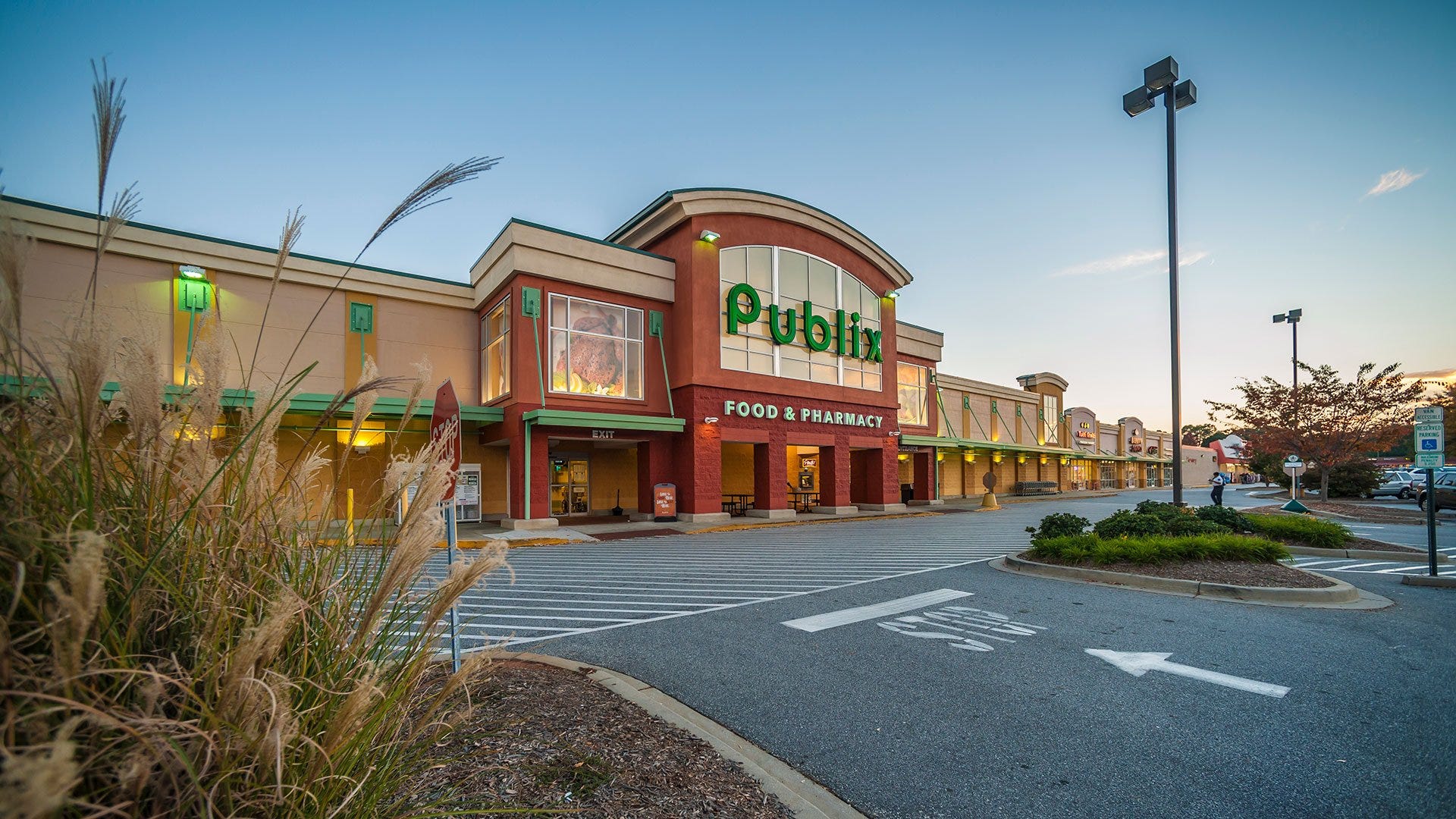
The Southern Appalachian town of Ellijay just announced that a Publix will likely be opening sometime in the near future.1 I had written about this back in February 2025. It was my very first Substack post about the scourging of the small townships in my area due to sprawl. Mainly due to the infinite growth mentalities of chamber of commerce politicians and poor imaginations from many local leaders. In that piece I lamented about the grotesque electrical lines being put between Blue Ridge and Ellijay, and I made a comment about how the town 22 miles south of us, Jasper, had recently gotten a Publix and it was a sign of things to come. And no this isn’t a metaphysics of Publix type piece because honestly I don’t go to Publix enough to really know its ambient all that well. I do love the subs combo in their delis though.
My hope is that by putting words to what many of us sense but don’t articulate, someone reading this in Tennessee, Ohio, Texas, or upstate New York might look at their own hometown with new eyes. Maybe it sparks something. Maybe it spurs a healthier kind of civic imagination for you and helps you think of particularism as a practice. Maybe it will help in your stubborn defense of a town’s real identity, its local texture, its inherited character. I’m not an anti-growth type of guy. People move in. People move out. Communities trade influences, languages, and habits. There is such a thing as healthy, organic growth. In my last piece I wrote about the monoculture that’s infecting almost every American town, an almost town-franchise model as a kind of economic template, repeating itself across the map until everything begins to feel like everything else. It’s not that every chain or subdivision is evil. It’s that the system has a way of sanding down local distinctiveness over time. Little by little, the particularities that once made a place itself get replaced by a standardized “somewhere” that could be anywhere. Every town becomes nodes in a broader regional super metropolitan area.
Personally, I like some of the comforts of standardization in the American way of life. I enjoy being able to get a predictably tasty Italian BMT sub with a Coke Zero and barbecue chips at just about any Publix I walk into. The bread is reliably good. The Boar’s Head meat is consistent. You know what you’re going to get. That’s one of the silver linings of franchised expectation, is its strange kind of reassurance of expectations. Sometimes our world is often degraded and careless, and for me, there’s something almost consoling about competence. So, the question here isn’t whether Publix is “good” or “bad.” The question is what does it mean when a Publix opens in your small town? What does it signal about who is arriving, what kind of economy is forming, and what kind of “normal” is taking root? Of course, there is no broad answer since it really depends on what your town looks like and its local variables. I can only answer this by introducing Ellijay to you.

Ellijay is the Apple Capital of Georgia. It sits in the Blue Ridge Mountains in Gilmer County, where it serves as the county seat. It’s tucked into a basin of ridgelines and rivers. Coming north from Atlanta on the 515, it is the first county that has peaks over 4,000 feet. Not far from here, the Appalachian Trail begins on Springer Mountain. The Benton McKay trail also crisscrosses the county on the west side. And on that side are the Cohuttas—one of the largest true roadless wilderness areas east of the Mississippi, a rugged temperate rainforest of deep hollers, trout streams, gorges, rhododendron tunnels, and steep old ridges I’ve spent years walking and writing about. My family’s cabin is actually tucked at the very remote edges of this area. It’s also been named the mountain bike capital of the state and has some of the best riding in the Southeast.
Ellijay is also a town shaped by water. The Ellijay River and the Cartecay River meet near downtown to form the Coosawattee, which eventually drains into Carters Lake. The whole area carries that North Georgia feeling for many Southerners. Mornings here from a ridge carry a soft, mineral air, haze on the distant peaks. It is one of the most beautiful places in America in my opinion. We’re about ninety minutes from metro Atlanta, which means Ellijay is close enough to be an easy weekend escape. Suburban families and city people come up for fresh air and mountain views, for apple orchards in the fall, and increasingly for the wine country that’s taken root here—something like a dozen wineries now, and more coming.
I’m not writing this as a romantic who thinks the past was pure and the present is poison. Ellijay is not a museum nor is it perfect either, and I’m not asking it to be one. It has its problems, like any real place does, and some of the “charm” outsiders project onto small towns is just their own fatigue with city life. And the truth is that tourism—the very thing that keeps a town afloat—can also hollow it out. It shows in the slow conversion of entire neighborhoods into Airbnbs, the rent that climbs beyond the paychecks of the people who actually keep the place running, the young families who realize they can’t afford to stay where they were raised, the local worker driving farther and farther out into the county because the housing in town has become expensive as hell in the most basic way. I’m not interested in the Hallmark version of rural America, even though Ellijay has been compared to Mayberry at times. In fact, if you’re reading this from far away, I want you to come experience it. I want you to drive these roads, smell the apple orchards in the fall, sit by the rivers, watch the ridgelines catch the evening light, and love it the way I do.
A Publix picking a town of 1,800 people to open up is a sign that the composition of that community has changed. It’s a sign that the town is now a regional node. Publix it’s not just a grocery store in the conventional sense though of course it is. It is an institution of controlled normalcy for suburbanites. It not a Walmart. Ellijay already has a Walmart. A corporation like Publix will only open in a community and will only thrive when there is a certain kind of expectation that has become thick enough in the community itself - an expectation that life should be smooth, clean, even if the groceries cost a little bit more. That maybe the community now expects there to be more options. That’s when Publix shows up. And that’s where the deeper tension begins. The locals who are skeptic and perhaps upset, are not simply allergic to change. Many of the locals are actually people originally from out of state who have been living in Ellijay since the early 2000s and even 90s. Many of them came and grew fond of this small Appalachian town that in those times was likely quite quaint. Many of them can sense, in their bones, what a Publix for what it really is, a flag planted for the second economy. The economy of visitors, in-movers, and second homes; the economy of the weekend; the economy of people who can leave if the place stops pleasing them. It tells every developer, every realtor, every investor scrolling a map from a city apartment, this place is safe to bet on. It is no longer only just an apple town with a history and particularity.
There have always been real estate investors in Ellijay since time immemorial. Every mountain town has always had its land men, its speculators, its quiet buyers who saw value before the rest of the world did. But something has changed in the last decade, and it isn’t merely the number of outsiders. It’s the lens through which the town is now perceived. Ellijay is no longer simply a place where people live, raise children, and bury their dead; it is increasingly processed from every angle through a market vantage point. And markets, by their nature, do not just discover places. They tend to rewrite them in their own image, translating what is stubbornly local into abstract marketing categories that can be priced, packaged, branded, optimized, and sold. The local chamber wastes no time in packaging curated experiences with certain expectations.
That is why the arrival of a Publix, especially planted along the 515 highway corridor feels like more than a grocery store. It is the moment a town becomes readable to the American suburban imagination; safe, clean, competent, familiar, navigable. The town gets shinier. The edges smooth out. Certain forms of inconvenience, such as unpaved gravel roads—once endured as the cost of living in a real place—are treated as design flaws to be corrected. The Publix demographic, for whatever things people make about it, brings real goods. They bring spending. They bring a higher bar for service. They bring more reliable jobs, and they tend to reward competence. They bring what you might call a suburban moral economy in form of manners, predictability, expectations. In a nation that increasingly feels frayed, that can look like a form of order returning—almost a civic comfort of excellence. And if you love a small town, you can admit this without embarrassment. Not everything that arrives from the outside is a parasitic. Some things are genuinely better. In a strange way as I said, this standardization can be good, like someone finally showed up with standards after the long American slide into shabbiness and dysfunction. The bathrooms are clean. Someone gives a flip. The employees smile. The lights are bright in a way that suggests confidence. And for the families who have been here a long time—who have watched stores degrade, watched options thin out, watched the nearest “nice” thing drift farther away—there is a real and understandable relief in that!
This of course brings a type of cultural pressure. Once a place becomes legible in this manner, it becomes recruitable. It enters the national circulation of desire. This is how markets colonize towns without ever meaning to. A market doesn’t ask, “What is this place, in its soul?” It asks, “What can this place become, at scale?” And the answer is almost always some version of the same thing across America that has worked to make numbers on a chart go up. It means more units, more traffic, more services, more retail nodes, more “quality of life,” more development that looks like every other development because the templates are already built and the financing already understands them. The town begins to resemble an airport, clean, efficient, safe, and strangely interchangeable from any other town in the United States.
Many of the homegrown locals who have lived in Ellijay for generations are actually quite open to change—sometimes more open than the outsiders imagine. What’s interesting is that a meaningful number of them have done well precisely because they inherited land that has appreciated exponentially in value, and so they’re not merely passive witnesses to transformation; they can become its conduits, even its architects. Of course, not everyone falls into that bucket, and plenty of old families have been squeezed in quieter ways too, but the broader point remains that in a small town, “local” does not automatically mean “anti-growth,” and “newcomer” does not automatically mean “the problem.” And as a Catholic who believes in subsidiarity, I’m not upset by locals making decisions about their own land and their own future—what could be more natural than that? The trouble is that there’s also a subtle spiritual cost to legibility. What makes a small town a place is often its slight resistance to the broader consumer world—its thickness, its quirks, its lore, its stubborn particularity. The arrival of a Publix marks the point at which Ellijay becomes readable to the broader world, a service node on a corridor where people from outside come to shop, refuel, and “do the mountain weekend.” Ellijay in 2026 got a thick enough layer of households who buy normal life the way suburbs do—plus our seasonal visitors—so a premium grocer can live off repeat weekly baskets, and Publix is the official recognition that this second layer has become large enough to shape the market, and therefore, over time, to shape the town.
Change in a small town is as old as the ridgelines, and any honest love for a place has to make peace with time. At the very least, though, Ellijay seems to be attempting a kind of boundary, hemming most of the corporate growth to the highway. And even as I bemoan the development of the 515 corridor—I can admit the wisdom of the compromise. I personally still detest highway growth as I’ve seen how it’s hollowed out my hometown. This is because highways are not just roads, they are liminal spaces, where the distance between towns allows you to feel you’ve crossed into a different world. I like there being a significant difference when you travel to a town. I like arriving somewhere that is palpably itself. I’m also grateful, too, that so much of the county still feels protected providentially by national forest holdings.
It’s very unlikely all of this is going to arrive alone. Publix itself won’t ruin Ellijay. It’s the second-order development that can. There is no doubt that many other businesses are going to orbit Publix. And the danger is not that any one project is catastrophic; the danger is the logic of “just one more.” Just one more bypass. Just one more widening. Just one more sign. Just one more subdivision cut into a hillside. This is how Anywhere, USA is built incrementally, politely, with no specific villain to blame, thus, nothing is accountable.
If growth is going to happen, it must be governed by a kind of deliberate love. We must be willing to follow a few field guide rules. Keep the big corporate growth on the highway, where it can serve its purpose without swallowing the town. Keep downtown curated and human-scale, a place meant for walking, lingering, leisure, and recognition rather than utilitarian throughput. Be ruthless about signage, landscaping, setbacks, and building materials. Aesthetics are never neutral; they are policy written in wood, stone, and asphalt whether anyone admits it or not. Incorporate as much genuine Appalachian forms as possible. Plant native shrubs and trees in public spaces. Beauty is real. And above all, resist letting the highway node creep inward under the soft sirenic spell of “just one more project,” because that is how boundaries fail and how a town slowly forgets where it begins and where it ends.
I’m also writing this partly as a memo to myself—something I can read back, God willing, in twenty or thirty years, to see what Ellijay became, and whether we had the courage to keep its face intact. Publix is where two Americas meet. Ellijay will answer in the next decade how it managed its growth. The real question is whether Ellijay can grow like a place that knows what it is or will it dissolve into the smooth, frictionless, highly shoppable nowhere that America keeps building. I know Ellijay’s soul and I will always remember what this town felt like. Thought when its all said and done, you can be damn sure I’ll be in that Publix myself one day, ordering a pubsub after tubing on the Cartecay river on a hot summer afternoon with my daughter.
Buy me a coffee if you enjoyed this piece.
Source: Publix coming East Ellijay - Joint Development Authority Gilmer 8am 02-03-2026 - YouTube -
Wait they have grocery stores with sandwiches that taste like Firehouse in the States?