

Vandals with permits
How Ellijay’s landscape was scarred in broad daylight

I didn’t grow up in the mountains. I grew up in the Ridge & Valley, where the land rolls rather than rises, where the horizon is broad but never towering. When we wanted to pass through the mountains, we took the 136 or rode up 515, winding our way through Ellijay one way or another. It was always here that my shoulders first relaxed. There was always a moment right when I got to Ellijay, sudden and unmistakable, when I felt it. I had left the foothills behind finally.
The lowlands I was raised in had always felt restless to me, the air too thick, the roads too straight, the land too tamed. But in these hills, I felt something different. Ellijay was my gateway to the mountains, the place where I first understood that geography is important. It was the first place that felt mine. I still remember the quiet awe of that drive up 515, watching as the distant peaks unveiled themselves beyond the trees, the first real mountains I had ever seen!
I made it a priority in my twenties to move to Ellijay. It was not a passing dream but a pull, something deeper than preference. Something providential. I had fallen in love with the Cohuttas in northwestern Gilmer County, and from that moment, I knew I wanted to love this area more. How I finally arrived is a story for another time.
There was a purity here in Ellijay, the shire-like landscapes that inspired me. Bear Creek Trail, lush and beautiful with primeval old growths. Cabins, tastefully tucked into the hills. Cleared pastures that blended into the land rather than imposing on it, with agritourism that complemented the rural character rather than clashing with it.
But now, at the gateway in Ellijay, where you once could glimpse the 4,000-foot peaks in the distance but now you’re greeted instead by an army of grotesque electrical towers. Their metal frames slash across the sky like scars on a once-pristine landscape.
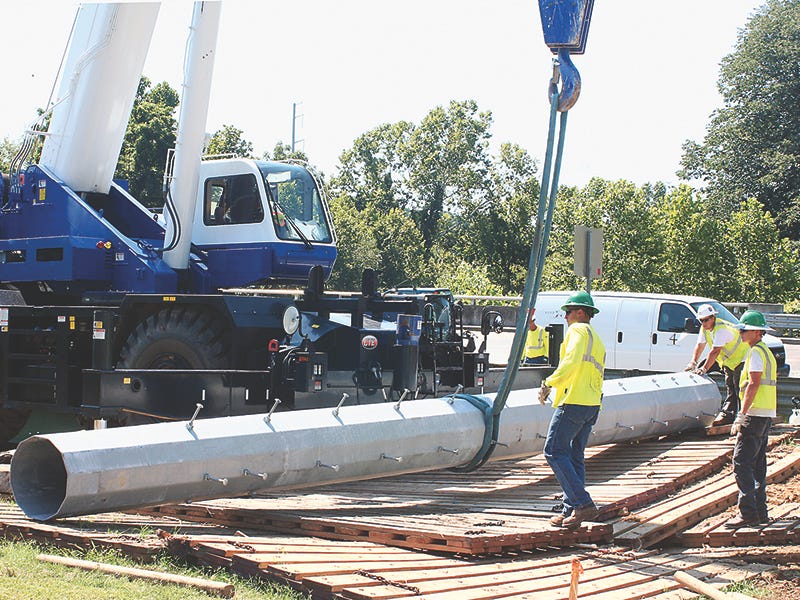
A $35 million electric power transmission project is now underway along Highway 515, set for completion by mid-2025. These transmission poles, up to 100 feet high, have been planted like industrial tombstones along the route, rising above the trees, announcing that beauty is no longer a priority, only function, only utility. The word “form” isn’t even in the known vocabulary of the people that made this decision.
Some will say this is necessary, that we need these transmission lines for progress, for infrastructure, for reliability. I understand that. The electrical grid is important, and people need power. But let’s not pretend this is the only way to do it. These lines weren’t built to keep Ellijay’s lights on; they are transmission lines, carrying power far beyond here, with Ellijay paying the aesthetic cost. This wasn’t a question of keeping homes warm in the winter, it was a question of convenience, of corporate expedience, of putting up the cheapest, most direct option rather than considering how to build with respect for the landscape.
And as for jobs? I don’t care. If jobs alone justified everything, we’d have strip malls covering every inch of land from here to Blue Ridge. Small towns like Ellijay don’t survive by paving over their identity in the name of economic development. The people who come here, both tourists and residents—do so because of the beauty, because of the character, because Ellijay still feels like somewhere worth being. Destroy that, and you destroy the very reason people want to be here in the first place.
The defenders of this project insist that the poles will “blend in” over time. As one official told the Times-Courier:
“And when you’re digging up dirt and you’re digging up that Georgia red clay, it’s very, very noticeable. However, over time—as vegetation starts to grow in and hide some of that Georgia red clay, and the galvanized steel poles start to weather and become less shiny—those poles have a tendency to blend into the skyline around it.”
What a pitiful defense. These people speak as though a scar “blends in” over time, as though a wound becomes part of the body simply because the pain dulls. To say that these towers will fade into the landscape is an admission that they have defaced it. This is the language of a civilization that no longer believes in itself. Once, we built cathedrals and soaring architecture that pointed upward, that ennobled man, that reminded us of something higher. Now we erect galvanized steel monstrosities and tell ourselves they will “blend in.”
It is an insult to our intelligence, but worse, it is an insult to our home. Our neighbors just south in Pickens County have long been overrun by pavement, their natural distinctions erased by sprawl. Jasper is getting a Publix now, a sign of things to come. Shopping centers, new developments, creeping expansion. Not all of it is bad in itself, but it changes a place. What was once a mountain town becomes just another exurb, another waystation between bigger cities. The old sense of separation, of being somewhere distinct, fades.
Ellijay had resisted. Not by legislation or activism, but simply by virtue of what it was, a town with an identity. A place where you could feel the separation from the lowlands, where the mountains announced themselves, where you could drive along 515 and feel as though you were passing through the mountains. But no town resists forever, not if its people don’t fight for it. Beauty is a resource.
This is not sentimentality, it is an objective feature of the world, as real as water, timber, or minerals in the ground. And just like those, it can be destroyed. If a river is dammed or diverted, the ecosystem changes. If a forest is clear-cut, it does not return for generations. If a landscape is scarred by careless development, it does not simply “blend in” over time, it is lost.
Modernity does not pause. It does not consider. It does not ask permission. It spreads its wires and asphalt, its noise and neon, until no refuge remains. Originally, these towers were planned for Boardtown Road. This road, just two minutes from downtown Ellijay, is one of my wife’s and my favorite scenic backroads where their presence would have been an even greater tragedy. Luckily, citizens and property owners fought back, and they won. And good for them. But the war was merely redirected. Now these steel behemoths stretch all the way to Blue Ridge, industrializing what was once a corridor of natural beauty.
And for what? The justifications are always the same: efficiency, infrastructure, progress. They speak of power, but never of beauty. These people are vandals with permits as late Sir Roger Scruton used to say. Beauty is the most precious resource a town like Ellijay possesses. Without it, what are we? Another forgettable roadside stop, another casualty of sprawl? Leaders must understand that beauty is not a luxury. It is not something to be compromised, bargained with, or sacrificed for the sake of expedience. It is the foundation upon which culture, tradition, and even economy stand. Destroy beauty, and you destroy the very thing that makes a place worth living in at all. To those who think this is an overreaction, I say this: Look at the skyline now. Then imagine it five years from now. Ten. Look at what was lost.
"Beauty is vanishing from our world because we live as though it does not matter."
– Roger Scruton
A civilization that does not build with beauty in mind is not building at all, it is merely consuming. And if we do not stand against this slow erosion of the beautiful, what will be left? A place no different from any other, where history is paved over, where nature is framed only by power lines, and where the grandeur of the mountains is upstaged by the tyranny of utility. Leaders must learn this: it is not enough to preserve economic growth—we must preserve beauty. Otherwise, we will wake up one day to find that Ellijay, the town we love—has been erased and replaced with something completely alien.